August 9, 2026 · Jason Strickland
Every Placement
What older climbers taught me about slowing down, service, and the difference between purpose and proof.
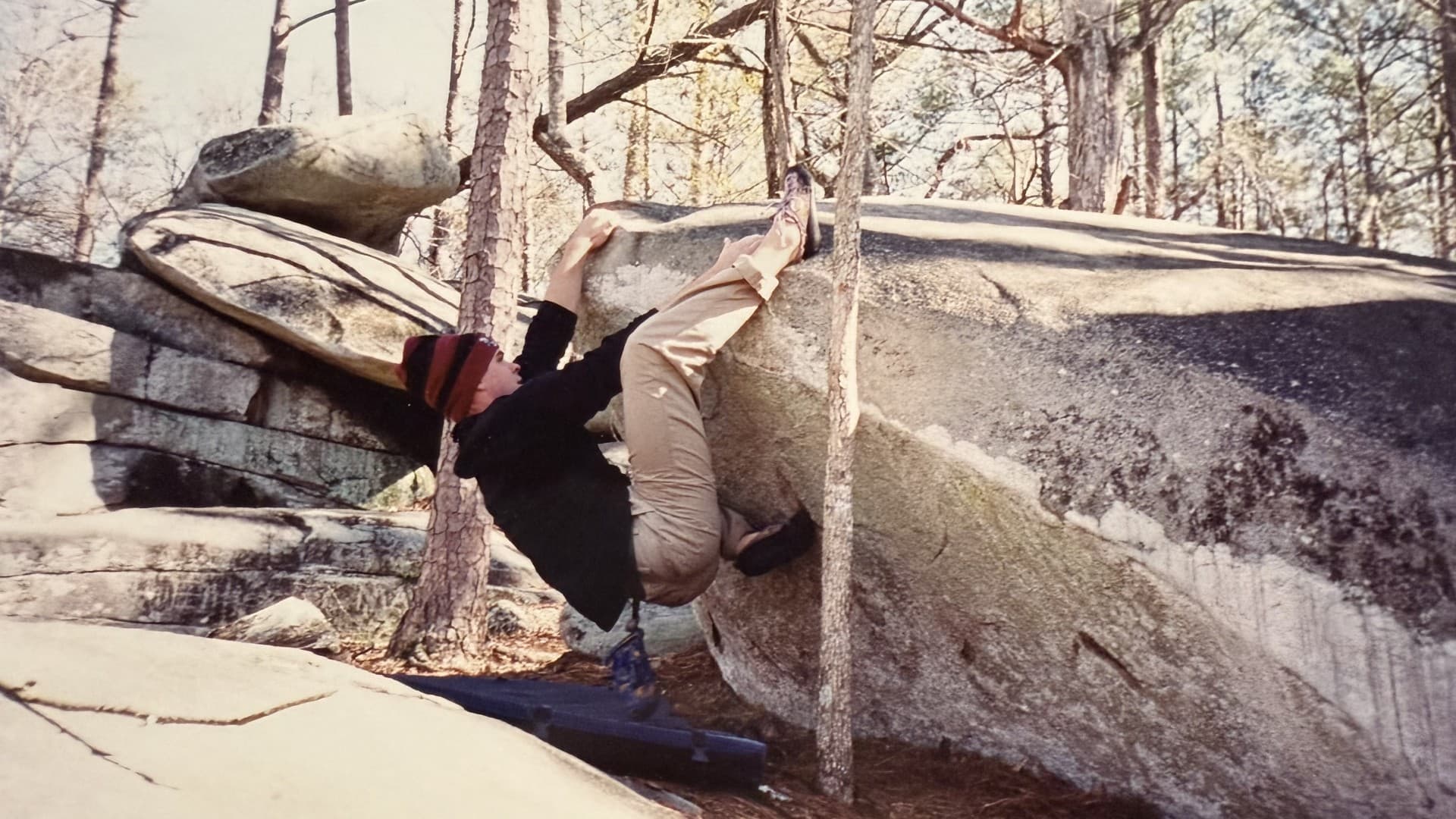
Thirty years ago, when I first learned to rock climb, I was a young man with something to prove. How hard could I climb? How many feet could I cover in a day? How strong could I become? Every route had a grade, every day had a total, and every achievement created another number to pursue.
It took me years to understand what was underneath all that urgency.
I tried Little League when I was young, but living in a rural area with no one nearby to play with and a father who did not seem interested in playing catch made for a disastrous single season. That experience left me eager to test myself physically but uninterested in organized sports. I lifted weights as a teenager, but everything clicked when my pastor's son, Rocky, ironically enough, took me to a local bouldering area. I saw a guy in strange-looking shoes scrambling up the rock, and something in me recognized it immediately. I bought a pair of climbing shoes that week and spent countless afternoons scrambling over granite eggs perched beside a swamp in North Georgia. Climbing gave me a place to connect my physicality with my nearly insatiable desire to solve problems.
The results were mixed. I had some extraordinary experiences. I also developed bad habits, collected injuries, and got in over my head more than once. A few of those days could have ended very differently. I mistook pushing harder for progress and checking boxes for success. After college, I moved from Hull, Georgia, to Dolores, Colorado, and fell in with a group of older climbers who lived in town. Most were in their forties or early fifties. They had already lived through their own wild years, and they carried themselves differently. They would take me into the canyons, usually to go bouldering. There was less talk about how much ground we would cover or what grade someone intended to climb. Nobody seemed to be auditioning.
That was where I finally began to slow down and see the world around me.
One of those men was named Mark. He climbed so slowly, smoothly, and methodically that I often could not tell how difficult the problem was. It did not matter whether he was climbing 5.8 or 5.12. The quality of his movement remained the same. He paused before placing every hand and foot, suspended on three points in perfect balance, slowly letting his fingers or toes settle onto the rock. Mark taught me to feel every movement and take time with every placement. He showed me that the point was not simply to arrive at the next hold. The way I moved toward it mattered. Another mentor was a farmer named Chuck. Some days he would go as hard as I wanted, if not harder. Other days, he would fall asleep in the shade at the base of the crag while the rest of us climbed. Glen taught me to face fear. What did it mean to be truly runout, making questionable moves above bad gear? How could I control my mind instead of burying the fear beneath another hard push? Be smarter. Conserve energy. Make the next move deliberately rather than treating forward motion as the only acceptable choice.
The way I moved toward it mattered.
At the time, I did not recognize any of this as mentorship. There were no formal lessons, no curriculum, and no speeches about becoming a better man. There were just older men taking a younger man into the canyons and showing him, through the ways they moved and sometimes did not move, that he did not have to turn every experience into a test. They taught me to climb for something other than the grade. Not for approval. Not to establish my place in the group. Not to prove that I deserved to be there. I could climb simply because I loved climbing.
I wish I could say the lesson took hold everywhere at once. It did not.
For much of my professional life, I carried the same hunger into my work. I was always in service of other people, but often in the wrong way. I built what I thought would earn approval. I solved problems before anyone had clearly asked me to solve them. I made myself useful because usefulness felt like security. From the outside, that can look like dedication. Sometimes it was dedication. Sometimes it was people-pleasing with better project management. At my worst, it was ego telling me that I knew better than everyone else and that, if they would just listen to me, it would all work. Like climbing, it took a few hard knocks to understand that pushing harder does not necessarily make anything better. The shift came when I slowed down enough to listen to what people actually needed. Not what I could impress them by building. Not what demonstrated the full reach of my capability. What would genuinely serve the person or problem in front of me?
That changed the work.
True service requires more than effort. It requires restraint. It asks me to feel the placement before committing my weight to it. It asks whether the next move belongs to the work or to my old need to prove myself. Sometimes the most capable response is to build less. Sometimes it is to wait. Sometimes it is to admit that the thing I am eager to offer is not what is needed. I did not learn those principles in an office, a leadership program, or a consulting framework. I learned them in the canyons outside Dolores, watching older men climb without needing the mountain to tell them who they were. It took the rest of my life to understand what they were showing me. Move slowly enough to feel what is true. Make each placement with intention. Let the work be difficult without turning it into proof.
And when the reason for climbing disappears, remember that joy was always reason enough.